| Brand Name: | Xingtongli |
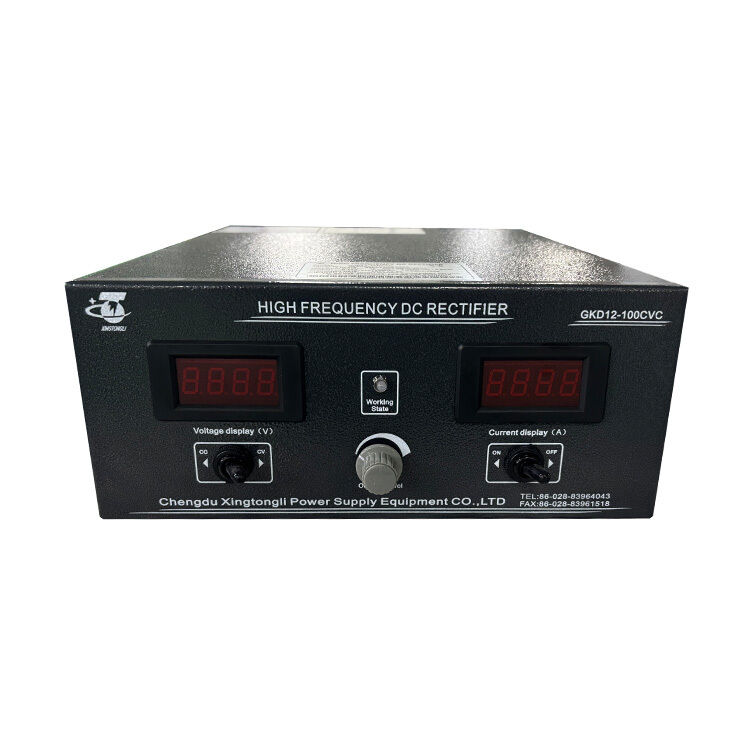
| Model Number: | GKD12-100CVC |
| MOQ: | 1pcs |
| Price: | 480-650$/unit |
| Packaging Details: | strong plywood standard exporting package |
| Payment Terms: | L/C,D/A,D/P,T/T,Western Union,MoneyGram |
This 12V 100A low ripple rectifier is tailored specifically for selective electrodeposition processes. In the field of precision electroplating, traditional high-power power supplies often struggle to meet the needs of localized fine processing - ripple interference can lead to uneven deposition layers and rough edges, while the insufficient stability of ordinary power supplies can further affect the quality and bonding strength of the plating layer. Selective electrodeposition is an advanced localized electroplating technology that is as precise as "minimally invasive surgery", depositing metal only on specific areas of the workpiece. Compared to traditional bulk electroplating, it can precisely control the position and thickness of the plating layer, making it particularly suitable for precision fields such as microelectronics and aerospace that require localized strengthening or repair. It significantly saves precious metal materials while enhancing performance, achieving precise processing that "plats where you point".
| Brand Name: | Xingtongli |
| Model Number: | GKD12-100CVC |
| MOQ: | 1pcs |
| Price: | 480-650$/unit |
| Packaging Details: | strong plywood standard exporting package |
| Payment Terms: | L/C,D/A,D/P,T/T,Western Union,MoneyGram |
This 12V 100A low ripple rectifier is tailored specifically for selective electrodeposition processes. In the field of precision electroplating, traditional high-power power supplies often struggle to meet the needs of localized fine processing - ripple interference can lead to uneven deposition layers and rough edges, while the insufficient stability of ordinary power supplies can further affect the quality and bonding strength of the plating layer. Selective electrodeposition is an advanced localized electroplating technology that is as precise as "minimally invasive surgery", depositing metal only on specific areas of the workpiece. Compared to traditional bulk electroplating, it can precisely control the position and thickness of the plating layer, making it particularly suitable for precision fields such as microelectronics and aerospace that require localized strengthening or repair. It significantly saves precious metal materials while enhancing performance, achieving precise processing that "plats where you point".